|
Rob’s newsletter for 2016
Leave a reply

|
I’m working on a project called the Future of Transportation as part of the Srishti Interim semester. See last years interim here

Text by Ewen Chardronnet
In a time of rapidly accelerating climate change, why do we still blast rockets into space, burning up vast amounts of hydrocarbons? Three weeks before the COP21, the UN conference on climate changes, international renowned artist Tomás Saraceno and his balloonists team, with the help of the Rubin Center for the Visual Arts in UT El Paso, has decided to build a “Space without Rockets” action in New Mexico White Sands desert area, the land of the first rocket launches in United States and of the first tourist spaceport in the world.
The new space race for commercial space flights and space tourism raise certain questions concerning climate change. The big threat from the scaling-up of space travel comes from black carbon, a type of particulate matter that, when hurled into the stratosphere, stays up for years, absorbing visible light from the sun. According to a study Black carbon emitted into the stratosphere by rockets would absorb 100,000 times as much energy as the CO2 emitted by those rockets. And emissions from 1,000 private rocket launches a year would persist high in the stratosphere, potentially altering global atmospheric circulation and distributions of ozone. The simulations show that the changes to Earth’s climate could increase polar surface temperatures by 1 °C, and reduce polar sea ice by 5–15%. A growing space tourism industry will function like an experiment in engineering the climate.
There’s one issue and it’s simple: you don’t want to put black carbon in the stratosphere.
What then? Are rockets the only way to get there? Tomás Saraceno says no, we can float into space with balloons, from space stations hovering in the upper atmosphere and calls for an Aerocene.

Tomás Saraceno’s project Aerocene proposes the longest 0-fuel flight around the world, powered only by the heat of the Sun and infrared radiation from the surface of Earth. Being a sculpture with research potential, it contributes to the ongoing dialogue between art and science and posits a new way to collect data, distribute information and translate scientific research through an artistic form.
Aerocene is a collaborative project that engages in disruptive, alternative, and collective interactions with space and space technology and appropriates and reinterprets existing data sets; its launch in the dramatic landscape of the desert, led by Tomás Saraceno, implies the initiation of the growing global movement of artist-scientist-activists who are working in such a way that the imaginary of space becomes an expansion of the social imaginary, providing alternatives to traditional state-based and emerging commercial interests.The sculptures that are part of this endeavour examplifies the way how we can fly just as the planet Earth is floating in its contact flux.
In the dunes of White Sands on sunday november 8th 2015, for the first time in the world, a registered solar heat powered balloon carrying a human person has floated more than 2 hours without touching ground – and burning any gas ! The test flight was successful !
“Space without Rockets”, the international campaign for sustainable space exploration and research, organized by Aerocene in collaboration with curator Rob la Frenais and the University of Texas at El Paso.
Space Without Rockets Conference: Alternatives in Space Travel, the launch of Aerocene sculpture and the demonstration of aerosolar ‘moon-walk’, with gravity reduced only by the heat of Sun happened at Rubin Center, The University of Texas at El Paso and White Sands National Park

Participants: Tomás Saraceno, artist who has begun the aerosolar movement, realised a number of lighter-than-air artistic projects (Becoming Aerosolar, Aerocene), and co-founded Museo Aero Solar collective; John Powell, founder of JP Aerospace; Rob La Frenais, conference chair and curator of the Aerosolar/Space Without Rockets project; Ewen Chardronnet of the Association of Autonomous Astronauts; Kathelin Gray, co-founder and Director of the former Biosphere 2 in Arizona, from Synergia Ranch in New Mexico; Nicola Triscott, Director of the science-art organisation The Arts Catalyst, London; Nahum Mantra, co-curator of the Matters of Gravity zero gravity exhibition; Cristobal Martinez of Post Commodity.
http://rubin.utep.edu/…/t…/tomas-saraceno-becoming-aerosolar
http://tomassaraceno.com/projects/news/
To see activities in the Rubin Center, El Paso’s Territory of the Imagination anniversary event, and to register for Aerosolar- Space Without Rockets click here
Here’s the conference programme:
Tania Candiani (click to download or click on image to enlarge)
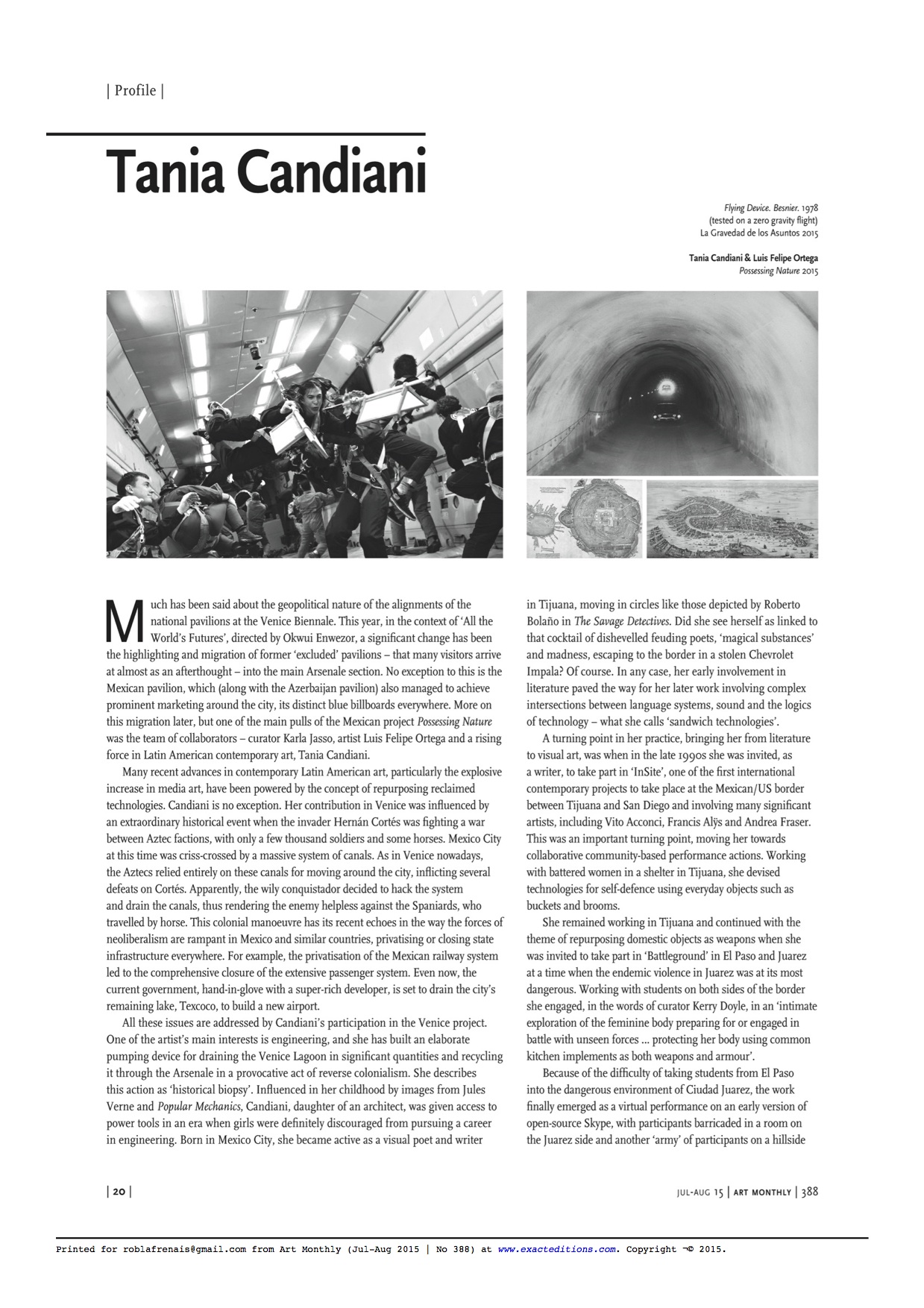
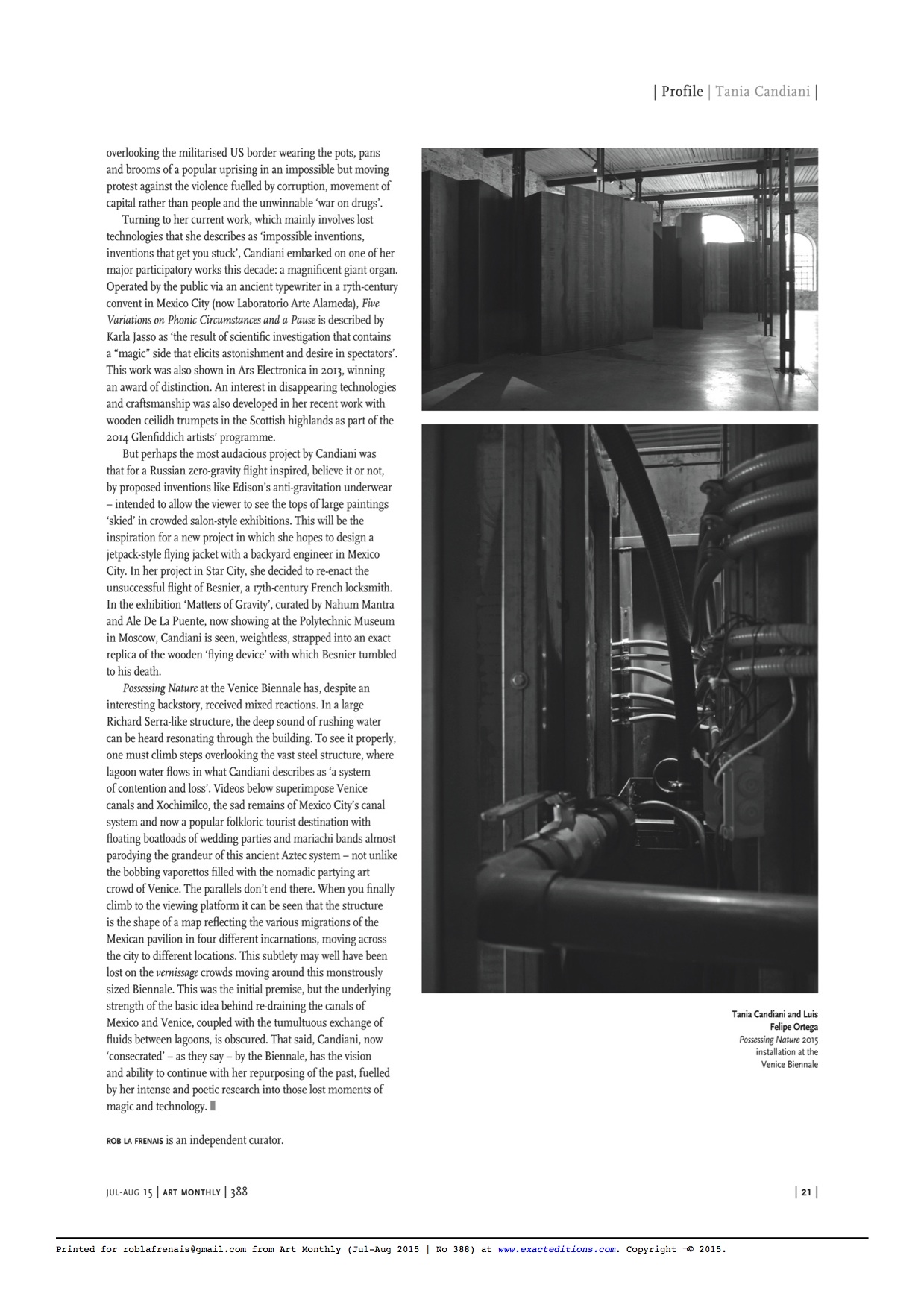
Copyright Exact Editions 2015. See Art Monthly Website
Article ‘Shifting Pavilions’ in thisistomorrow.info
Frontiers of Life
Terrestrial and Extra-Terrestrial Prospections
18th of June 2015 – University of Roehampton (London)
The question of life is a perennial problem that has puzzled philosophers since Antiquity. If one considers its modern scientific conception, one notices that life’s limits continue to shift and expand in remarkable ways. Current research in robotics, synthetic biology and artificial life redraws and questions traditional boundaries between what is alive and what is not. Life’s terrestrial origin is now thought to go back at least 3.5 billion years, as indicated by fossilized microbial mats. Its spatial distribution is more extensive and its resilience is much greater than generally assumed until a few years ago: biological organisms have been discovered in undersea volcanoes, in the world’s driest deserts as well as in subglacial lakes, and airborne microbes have been captured in the stratosphere. What is more, experiments conducted at the International Space Station in the European Space Agency’s BIOPAN programme have established that microscopic animals capable of suspended animation, such as tardigrades, are unexpectedly tolerant to the conditions of outer space. All this has inspired researchers in the field known as astrobiology to reassess the notion of ‘habitable environment’, to rethink what it means to be ‘alive’ and sometimes even to challenge the standard neo-Darwinian picture of the biological world head-on. Astrobiology, a veritable melting pot of a great variety of natural sciences, is arguably one of the most fertile grounds if one looks for creative reformulations of traditional neo-Darwinism. What remains underappreciated is that this development is very much in line with recent advances in the social sciences. In anthropology, several initiatives have been taken to rebuild our understanding of life and its evolution on entirely different ontological foundations. The perspective of ‘biosocial becomings’ (Ingold and Palsson 2013), which which explores alternative theoretical languages in relation to life, is one notable example of this trend.
The assumption here is that something can be gained from bringing both strands of thought together; the goal of this conference is to test the waters and to establish what that may be. The ethnographic exploration of astrobiology and planetary science – and of its practitioners’ observations, experiments and conceptual acrobatics in relation to life more specifically – is a first step. It is as important, however, to consider issues of scale and perspective. A key aim is to improve our understanding of how scientists make the universe palpable and how they apprehend both the very large (e.g. planets) and the very small (e.g. the inner structure of meteorites) by means of diverse kinds of telescopes, spectroscopes, microscopes and a variety of other instruments. Philosophers of science tell us that observatory techniques, and even objectivity itself, have a history. Space researchers may claim that their observations and measurements are objective, yet their ideals of objectivity change over time and depend on the specific context (or sub-discipline) in which they are applied. An astrophysicist may have a slightly different standard of objectivity and a subtly distinctive definition of life than –say – a geochemist or a microbiologist. The way in which planetary scientists frame their questions – whether it is about subsurface oceans, alternative biochemistries, ice volcanoes, extra-terrestrial lightning storms, putative microfossils or the analogy between the Earth’s hydrosphere and the ‘methanosphere’ of Saturn’s biggest moon Titan – and in how far these respective entities are considered to be ‘alien’ or ‘familiar’ are always based on specific but usually unacknowledged conventions. By explicating these conventions, this conference intends to document how specific ideals of objectivity are currently evolving within astrobiology and fundamental research on life.
Istvan Praet.
Venue
Richmond Room
Whitelands College
Holybourne Avenue
London SW15 4JD
Contact: Istvan.Praet@roehampton.ac.uk for more details
Programme
09.45 Welcome/ introduction
10.00 Gisli Pálsson (University of Iceland),
10.45 Coffee/tea
11.00 Sophie Houdart (Université Paris X Nanterre)
11.30 Jane Grant (Plymouth University)
12.00 Istvan Praet (University of Roehampton)
12.30 Lunch
14.00 Antonia Walford (The Open University)/ Donnacha Kirk (UCL)
14.30 Valentina Marcheselli (University of Edinburgh)
15.00 Rob La Frenais (Independent contemporary art curator)
15.30 Coffee/Tea
16.00 Perig Pitrou ((Laboratoire d’Anthroplogie Sociale/ Collège de France)
16.30 Klara Capova (Durham University)
17.00 Summary of the day – Jane Calvert (Edinburgh University)/ general discussion
17.30 David Dunér (Lund University)
18.30 Concluding remarks/ dinner at the King’s Head Pub


